

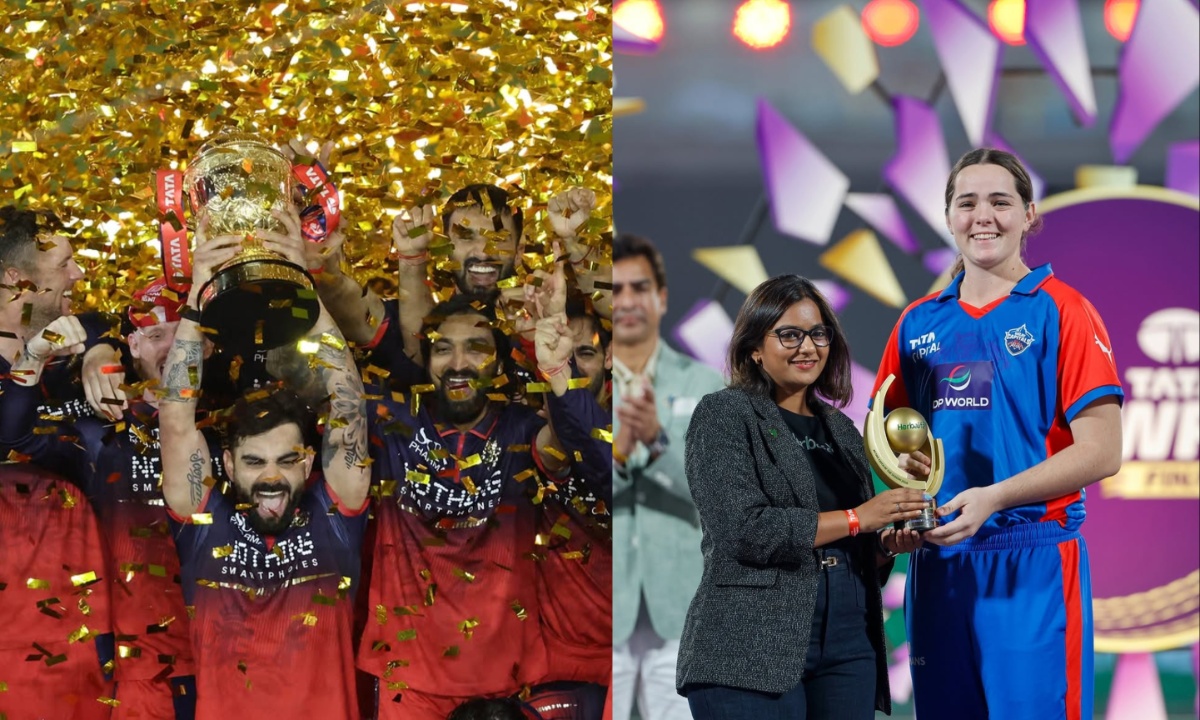
The launch of the Indian Premier League (IPL) in 2008 transformed Indian cricket forever. The tournament not only unearthed several young men’s cricketers but also provided them with financial security and a global platform to showcase their talent. Recognising the success of the IPL, the Women’s Premier League (WPL) was introduced in 2023.
Although both tournaments follow the same T20 format and are organised by the BCCI, they differ in several key areas, including team structure, tournament format, player salaries, fan engagement, and overall scale.
IPL vs WPL: Number of Teams and Tournament Format
The IPL features a total of 10 teams, with each franchise playing 14 matches during the league stage. The tournament follows a four-match playoff system, consisting of Qualifier 1, the Eliminator, Qualifier 2, and the Final.
On the other hand, the WPL currently has five teams. The tournament follows a double round-robin league stage, followed by the Eliminator and the Final.
Prize Money: How Much Do IPL and WPL Champions Earn?
The IPL-winning team receives a prize money of ₹20 crore from the BCCI, while the runners-up are awarded ₹13 crore. The team finishing in third place receives ₹7 crore, whereas the fourth-placed team takes home ₹6.5 crore.
On the other hand, the WPL offers prize money only to the champions and runners-up. The winning team receives ₹6 crore, while the runners-up are awarded ₹3 crore.
Player Salaries: IPL vs WPL Auction Comparison
As we know, there is a significant difference between the number of teams playing in the IPL and WPL, and a similar gap can also be seen in their purse values.
In the IPL, each franchise has a purse value of ₹120 crore, where a team can buy around 18-25 players. On the other hand, WPL franchises have a purse value of only ₹15 crore, with teams allowed to select around 15-18 players.
You might be surprised to know that the base price in WPL ranges between ₹30-50 lakh, which is higher than the IPL base price of ₹20 lakh.
Talking about the record buys, Rishabh Pant holds the record in the Indian Premier League with a price tag of ₹27 crore, making him the most expensive player in IPL history so far. In the WPL, the record buy belongs to Smriti Mandhana, who was signed for ₹3.40 crore.
Overseas Player Rules in IPL and WPL
In the Indian Premier League, teams can include a maximum of 8 overseas players in their squad, out of which only 4 overseas players can be part of the playing XI.
On the other hand, in the Women’s Premier League, a team can have a maximum squad size of 18 players, including only 6 overseas players. During a match, a maximum of 5 overseas players can feature, which includes 4 overseas players and 1 player from an associate nation.
Broadcast Viewership and Global Reach
The Indian Premier League has a massive audience base, with a total viewership of 1.18 billion+. On the other hand, the Women’s Premier League has also made a strong impact, attracting 370 million+ viewers.
When we look at the year-on-year growth, the IPL audience has increased by around 7%, while the WPL has witnessed an impressive growth of 142%.
Both leagues are broadcast through their respective platforms, with matches available on Jio Hotstar and Star Sports.
Emerging Talent: Which League Creates More Opportunities?
The Indian Premier League has 170 domestic roster slots, whereas the Women’s Premier League has only 60 slots across its five teams.
The IPL has a much longer history, and when it comes to discovering and developing quality players, the league has provided Indian cricket with several talented stars since its beginning in 2008.
The list includes some of the biggest names in Indian cricket, including former India captain Virat Kohli. Apart from him, players like Jasprit Bumrah, Hardik Pandya, Suryakumar Yadav, and Abhishek Sharma have also emerged through the IPL platform.
These are just a few major examples, but the IPL has played a crucial role in producing several players who went on to represent the Indian cricket team.
Talking about the WPL, it started much later compared to the IPL and has completed only three years so far. However, even in this short period, the Women’s Premier League has managed to provide some promising talents to the India Women’s team, with Shreyanka Patil being one of the notable names.
If we compare the IPL and WPL, the Indian Premier League appears to be ahead in almost every aspect. However, we should not forget that if the men’s league is a fully grown tree, then the Women’s Premier League is a young plant that is growing rapidly.
With time, this small plant has the potential to grow into a strong tree and stand alongside the IPL in the future.